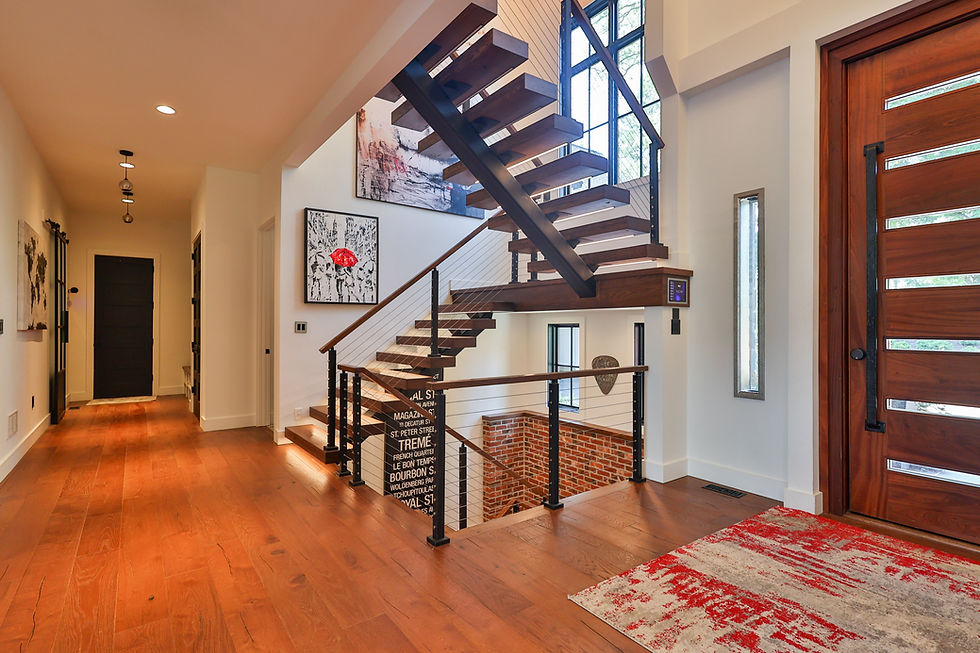
Elevating Your Interior: Expert Staircase Transition Ideas for a Seamless Home Flow
Updated: Aug 31

The Art of the Transition: Crafting Seamless Staircase Connections
In the world of interior design and architectural planning, the staircase is often treated as a standalone feature. However, the true mark of a master-crafted home lies in the transitions—how the staircase meets the landing, connects to the floor, and integrates with the surrounding wall architecture.
At Bilger Railing & Stairs, we believe that a well-executed staircase is not just a vertical path between levels, but a cohesive design element that dictates the flow and feel of your entire home. Whether you are remodeling an existing structure or working from a new set of blueprints, understanding how to manage these transitions is essential for both aesthetic appeal and long-term structural integrity.
Defining the Transition Points
Transitions occur at several critical junctures: where the bottom tread meets the main floor, where the stairs meet the upper landing, and where the handrail terminates into the wall or a decorative newel post. Many homeowners make the mistake of choosing stair materials or styles in isolation, failing to consider how these elements will "marry" with their existing flooring or wall finishes. This is where professional consulting, a hallmark of our service at Bilger Railing & Stairs, becomes indispensable. Our experts work with builders and architects to review prints early, ensuring that the transition points are planned with precision rather than left to chance during the framing phase.
Innovative Ideas for Floor-to-Stair Transitions
The most common area for design friction is the base of the staircase. To create a modern, high-end look, consider these professional strategies:
The Volute or Starting Step: Incorporating a circular or elliptical starting step can soften the transition from a straight stair run into an open foyer. This creates a welcoming architectural gesture that invites visitors upward.
Flush-Mount Transitions: For a clean, contemporary aesthetic, consider flush-mounting the stair treads to your flooring. By using similar wood species and stains, we can make the staircase appear as if it is emerging naturally from the floorboards. At Bilger Railing & Stairs, we utilize a wide variety of wood species, allowing us to perfectly match your existing flooring textures and tones.
Threshold Integration: If you are transitioning from hardwood to a carpeted living space, a custom-milled threshold can act as a bridge, providing a trip-free, elegant boundary that protects the edges of both materials.

Balustrade and Railing Terminations: The Finishing Touch
A railing system is only as good as its ending. Abruptly stopping a handrail can ruin the lines of a staircase. Proper termination is a subtle art that requires knowledge of code compliance and geometry. As a Level 1 Stair Code Certified professional, Mark Bilger emphasizes the importance of safety without sacrificing style. A common, sophisticated transition is the "gooseneck" railing, which allows the rail to rise, turn, and terminate into a wall or post with fluid grace. For those preferring a modern aesthetic, we can also design minimalist glass railing mounts that disappear into the floor or tread, providing a nearly invisible transition that maximizes light and space.
The Role of Material Continuity
One of the most effective ways to manage transitions is through consistent material selection. If your home features classic oak flooring, choosing a contrasting wood for your treads can lead to visual clutter. We recommend a balanced approach where the staircase complements the surrounding environment. Our team at Bilger Railing & Stairs specializes in custom wood species matching, ensuring that your new staircase feels like an original, integral part of your home’s character. Whether you are looking to replace old banisters with custom-turned wood pieces or installing a modern metal spiral staircase, the transition between your structural elements and your interior design style should be seamless.

Professional Consultation for Your Next Project
Staircase transitions are more than just cosmetic choices; they involve complex structural considerations that must meet strict building codes. Attempting a DIY approach to complex stair geometry often leads to gaps, uneven tread heights, or code violations that can impact the resale value and safety of your home. By partnering with experienced contractors, you gain access to professional expertise that saves time and money. Our team thrives on the challenge of difficult spaces and unique architectural requirements. We invite you to contact us today to discuss your vision. Let Bilger Railing & Stairs help you create a staircase that is not just a way to move between floors, but a stunning bridge between your living spaces, designed with expert precision and built to last for generations.